

Renewable Energy In The MENA Region Market Outlook To 2030
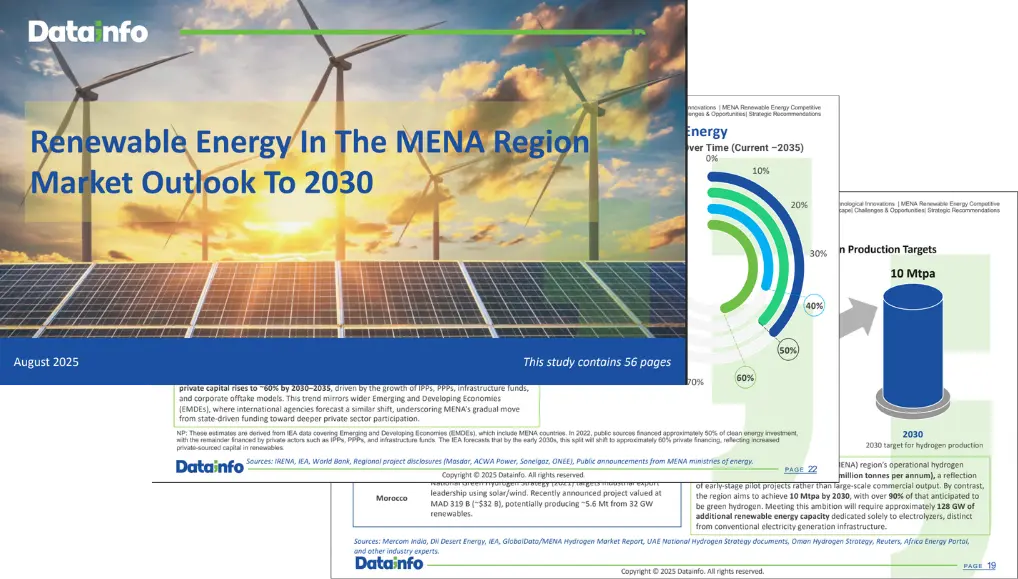
Renewable Energy In The MENA Region Market Outlook To 2030
The Middle East and North Africa (MENA) region stands at a historic crossroads. Long known as the epicenter of the global hydrocarbon economy, it is now poised to become a powerhouse of renewable energy. This transformation is not merely an environmental imperative but a core strategic economic one, driven by ambitious national visions, burgeoning domestic energy demand, and the immense potential for clean energy exports.
This report, "Renewable Energy In The MENA Region Market Outlook To 2030," provides a comprehensive and timely analysis of this profound shift. It moves beyond the headlines to deliver a data-rich, granular examination of the markets, policies, technologies, and competitive dynamics shaping the region's energy future. From the giga-scale solar projects of the Gulf to the pioneering wind farms of North Africa and the burgeoning green hydrogen ecosystems, the document offers an unparalleled overview of a region in rapid transition.
The insights within are critical for understanding how MENA is leveraging its natural advantages—unrivaled solar irradiance and vast wind corridors—to build a new, sustainable economic model. It details the challenges that must be overcome, from grid modernization to regulatory harmonization, and highlights the immense opportunities that lie ahead for investors, developers, policymakers, and technology providers.
As the global energy transition accelerates, the MENA region's role is becoming increasingly central. This report serves as an essential guide to navigating this complex and fast-evolving landscape, offering the strategic intelligence needed to make informed decisions and participate in one of the world's most dynamic clean energy markets.
The Report Will Help You
- Benchmarking: Compare your national strategies, regulatory frameworks, and auction designs against regional leaders and peers.
- Investment Attraction: Understand the factors that de-risk projects and attract private capital, from robust PPAs to grid integration plans.
- Policy Formulation: Identify gaps in local content rules, environmental standards, and hydrogen strategies to create a more bankable market.
- Market Sizing & Forecasting: Access validated data on market size (growing from $22.5B to $59.9B by 2030), CAPEX trends, and country-specific investment pipelines to allocate capital effectively.
- Risk Assessment: Utilize the detailed risk matrix and analysis of challenges (off-taker credit risk, currency volatility, grid delays) to accurately price risk and structure financing.
- Opportunity Identification: Pinpoint high-growth segments, such as green hydrogen, energy storage, and corporate PPAs, that offer attractive returns.
- Competitive Intelligence: Gain a clear view of the competitive landscape, including the key national developers (ACWA Power, Masdar, Scatec), their flagship projects, and strategic focus areas.
- Project Pipeline Analysis: Identify upcoming tender calendars and pipeline projects across different countries to inform bidding strategies.
- Partner Selection: Identify reliable EPC contractors, O&M providers, and technology suppliers with proven regional experience.
- Market Entry Strategy: Understand localization requirements, technology demand shifts (e.g., towards hybrids and storage), and the key decision-makers in the value chain.
- Product Roadmapping: Tailor solutions for the MENA context, such as desert-proof solar panels, robotic cleaning systems, and electrolyzer technology compatible with fluctuating renewable input.
Key Highlights from the Report
- Explosive Growth:The market will nearly triple from $22.5B (2023) to $59.9B by 2030 (15% CAGR).
- Gulf Dominance:The UAE (53.3%) and Saudi Arabia (29.3%) lead the market, driven by giga-scale projects.
- Rising Hydrogen:The hydrogen project pipeline surged 74% in one year. Green hydrogen's investment share will jump from 8% to 13% by 2030.
- Competitive Landscape:Record-low tariffs (e.g., $0.019/kWh in KSA) are achieved through intense competition and large-scale auctions.
- Critical Challenges:Off-taker credit risk, grid constraints, and policy uncertainty are the top barriers to growth.
- Financing Shift:Private investment is expected to rise to 60% of the market by the early 2030s.
Let’s Collaborate with Us!
Whether you’d like to connect about a prospective project or have a specific question about one of our products, we’d love to talk. Fill out this form and we’ll be in touch shortly.