

Middle East & North Africa (MENA) Green Construction Market Outlook to 2030
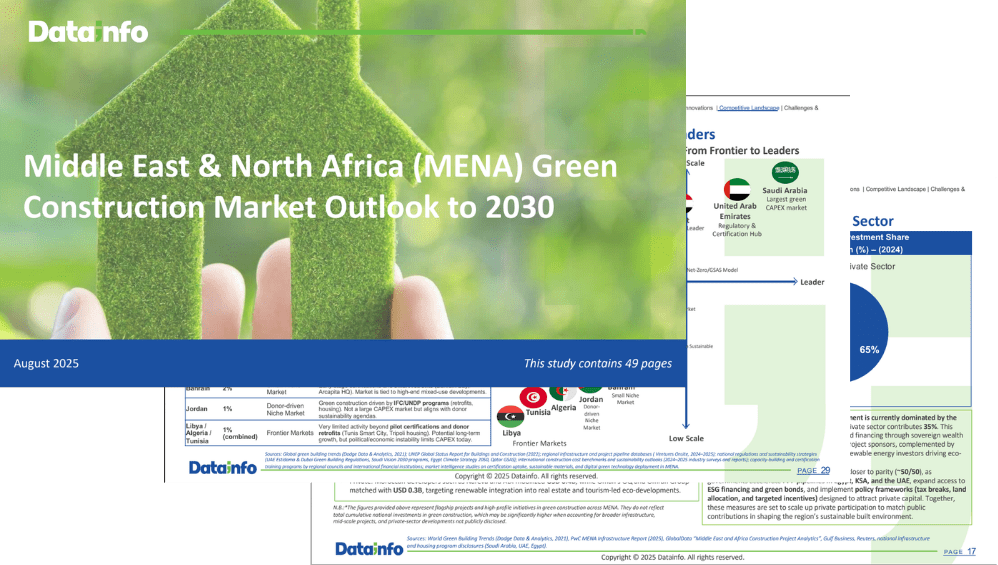
Middle East & North Africa (MENA) Green Construction Market Outlook to 2030
The MENA green construction sector stands at a transformative crossroads, shaped by ambitious national visions, large-scale gigaprojects, and a growing commitment to climate resilience. From Saudi Arabia’s NEOM and Red Sea Global to the UAE’s Masdar City and Egypt’s New Administrative Capital, sustainable building practices are no longer niche but are becoming a central pillar of regional development strategies. Governments across the region are embedding energy efficiency, low-carbon materials, and smart technologies into infrastructure and urban planning, positioning green construction as both an economic catalyst and an environmental necessity.
This report, compiled by Datainfo, delivers a comprehensive outlook on MENA’s green construction industry—covering market trends, regulatory frameworks, technological innovations, and competitive dynamics. Designed for policymakers, developers, investors, and sustainability leaders, it provides actionable insights into opportunities and challenges shaping the sector through 2030.
The Report Will Help You
This report is designed to assist:
- Policymakers in understanding regulatory frameworks and aligning national strategies with climate goals.
- Developers in identifying market opportunities, certification requirements, and technological trends.
- Investors in evaluating green construction projects, ESG compliance, and financing mechanisms.
- Sustainability Leaders in benchmarking performance, adopting best practices, and driving innovation.
- Contractors & Material Suppliers in navigating supply chain dynamics, localization opportunities, and competitive landscapes.
Key Highlights from the Report
- The MENA green construction market is projected to grow from $51 billion in 2024 to $128.8 billion by 2030, at a CAGR of 16.7%.
- Saudi Arabia and the UAE dominate the market, accounting for 40% and 28% of regional CAPEX, respectively.
- Green building certifications (LEED, Estidama, GSAS, EDGE) represent the largest market segment (43% in 2024), though net-zero and energy-efficient facilities are growing fastest.
- Public sector investment accounts for 65% of green construction financing, with private sector share expected to rise to 50% by 2030.
- Key drivers include national visions (Saudi Vision 2030, UAE Net Zero 2050), giga-projects (NEOM, Masdar City, NAC), and ESG investor pressure.
- Major challenges include high upfront costs, fragmented regulations, supply chain gaps, and workforce skill shortages.
- Technological innovations such as BIM, AI, 3D printing, and modular construction are accelerating adoption and efficiency.
- Strategic recommendations focus on harmonizing codes, localizing materials, scaling retrofits, and upskilling the workforce.
Let’s Collaborate with Us!
Whether you’d like to connect about a prospective project or have a specific question about one of our products, we’d love to talk. Fill out this form and we’ll be in touch shortly.